There
are two kinds of people: those
who like Scotch whisky and those
who don't.
I'm
now one of the former, but it
hasn't always been so, and
throughout my learning
experience I've observed that
many people who say they do not
like Scotch haven't really given
it a serious try. I now know
that it would be worth their
while to put up with what they
might call "some mild
discomfort" for a short time to
acquire a taste for the "Water
of Life" because, simply put,
it's worth it!
And
recently, I've become aware that
the majority of us who like the
aroma and taste of Scotch aren't
sure why we prefer a certain
brand, couldn't identify our
brand in a blind taste test with
other scotches, and generally
don't realize the specific
intricacies of the various
types, brands and tastes.
While
I'm still guilty of some of
these sins, I'm doing my best to
become a well-informed scotch
lover. I truly believe that
learning a bit more about Scotch
will significantly enhance
anyone's enjoyment of the
product.
So,
if you are somewhat interested
in learning more about Scotch, a
great place to start is in
Scotland. And, if you aren't
interested in Scotch at all, a
great place to start is in
Scotland!
So,
either way, you can't
lose.
Perhaps
the following tale will entice
you.
Four
Decades Ago
It
was a while ago that a special
friend of mine, Don Crone,
tasted a scotch produced in the
Hebrides of Scotland for the
first time.
It
was 1985 and Don was on a
business trip in Western Canada.
One evening he struck up a
conversation with a man whom he
had only recently met and during
the course of the evening the
topic of Scottish alcoholic
beverages came up. Much of it
was aimed at Scotch.
For
several hours, Don's new-found
friend expounded on the virtues
of a certain group of Malt
Whiskies produced on one of the
western islands of Scotland, a
place called Islay (pronounced
eye-la). He felt that several of
these scotches were unique
because of a heavier than normal
"peat" aroma and taste -
qualities which made them very
special indeed.
He
explained that the peat flavour
came from a combination of two
elements: first, the water used
to make the scotch, which flows
through the peat bogs on the
island prior to being captured
by the distilleries; and second,
the smoke from the peat fires in
the kilns where the barley is
dried prior to being ground into
mash for use in producing the
alcohol.
He
offered Don a list of a few
recommended brands; strange
names like Laphroaig,
Bruichladdich, Bunnhabain and
others. Don took notes.
In
the two weeks after Don's
return, he and I scoured LCBOs
and eventually located a bottle
of Laphroaig. It was like
finding the pot of gold! The
first taste was enough, at that
time, to send us on a mission to
seek out the others on the list
- a task which proved to be more
of an adventure than we had
expected.
We
managed to find two or three
brands tucked away in the back
rooms of some of the local
'Vintage' stores, but the
bottles were few and far
between.
One
evening, while sitting around
pondering our next move, we came
to the conclusion that if we
ever hoped to collect samples of
the remaining brands, we would
have to visit the island.
So,
in June 1986, we did just that
for the first time; and,
throughout the following four
decades I visited the island
again and again and again, and
to this day it still remains one
of my favourite destinations on
earth.
If
you are interested, read
on...
Getting
There!
Islay
is not the easiest place to get
to, but getting there is at
least half the fun.
We
used to start by renting our own
car and driving to Scotland’s
west-coast from either Glasgow
or Edinburgh. Indeed, my first
dozen trips involved this.
However, nowadays we tend to
travel together with a small
group of our guests in a
comfortable vehicle while our
guide and driver takes good care
of us along the way.
We
still follow the same path to
the north-west around Loch
Lomond, through the town of
Inverary and end up in Tarbert,
on the Mull of Kintyre, in
plenty of time to take in a few
pints before dinner.
Here,
the Stonefield Castle provides a
wonderful evening in the warmth
of its pub while we get to know
a few of the local Scottish
beverages.
Here,
we truly begin to feel the
traditional Western Scottish
hospitality, and even while
Scotland is a relatively
high-priced destination, we know
already that the trip is always
worth every penny.
So,
after a quiet night of toasting
our good fortune and enjoying
several cozy hours of sleep, we
all wake up to the smell of a
full Scottish breakfast.
It
usually starts with a huge bowl
of creamy 'stick to your ribs'
porridge! Then, we ready our
arteries for the shock of the
never-ending stream of bacon,
eggs, black pudding, toast,
fried potatoes, fried tomatoes,
fried bread and haggis. And just
to make sure we’re really awake,
we finish it all off with a
steaming cup of strong 'real'
coffee.
Then
we’re off to the ferry
terminal.
After
a short drive, we find the large
Caledonian and MacBrayne ferry
readying itself for the passage
to Islay. The crossing can
sometimes be sunny, but often
can be a bit wet, cold and
windy, but the experience is one
our guests won't forget.
About
two hours out, through the fog,
we make out the heather-covered
hills of Islay and its nearby
island of Jura. And as the ferry
nears the island, some of our
guests may begin to wonder why
they came. But patience! The
feeling will pass.
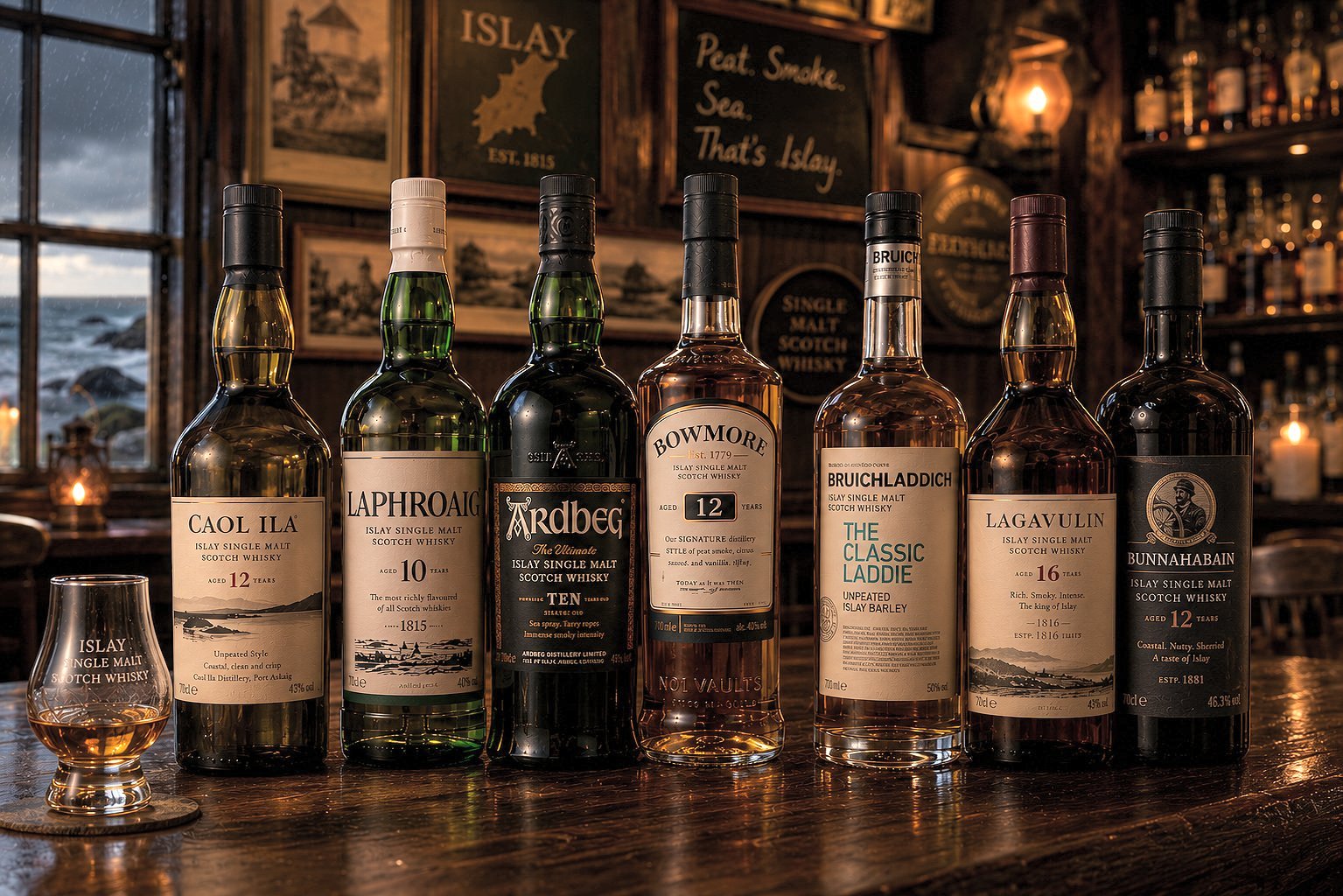
The
Islay Whiskies
When
we began visiting Islay forty
years ago, there were eight
Islay scotches, each produced in
its own distillery and each
having its own unique flavour.
Some were more 'peaty' than
others, but each had its own
special charm.
All
were bottled as 'Single Malts'
either by the island
distilleries directly or by
other 'off island' bottlers.
Many were also shipped in
barrels to mainland distilleries
to be mixed with other malt
Scotches, and eventually bottled
as 'blends'.
Our
personal visits to the island
distilleries were adventures,
and even before we arrived on
the island on our first visit,
we had the names of the eight
malts committed to
memory.
- Laphroaig
- Lagavulin
- Ardbeg
- Port
Ellen
- Bunnahabbain
- Bruichladdich
- Caol
Ila
- Bowmore
Recently,
three additional distilleries
have started up: Ardnahoe,
Kilchoman and Laggan Bay; but,
these initial eight whiskies
are
legends
in their own time and
the
tastes of each have now become
recognisable to us.
Whenever
we visit Islay, we still enjoy
the nightly ritual of
"three fingers and a
pint of heavy" - a
'wee dram' of pure, warm malt
and a pint of dark Scottish ale
enjoyed together like a couple
of old friends.
The
island offers even more to the
visitor, including enjoyable
dinner gatherings, local walks,
quiet sandy beaches, grassy
meadows, ancient historical
ruins, local wildlife, coastal
marine life, local
music, picturesque
whitewashed villages, sheep
shearing, the
woollen mill, evenings
by the fire, cozy pubs and small
shops.
After
a few days, just as visitors
begin to think they could easily
spend forever on Islay, it'll be
time to pack. And as the ferry
pulls away from the pier and
they watch the island slowly
fade into the fog, a warm
feeling will come over them - a
sense of satisfaction and a love
for the people of Islay.
Need
more convincing?
If
you're still not convinced, I
suggest you curl up with a "wee
dram" in front of your
television set some evening soon
and spend a short time soaking
up the magic of "Local Hero", a
motion picture by Bill Forsythe
with music by Mark
Knopfler.
This
movie was filmed in coastal
Scotland but ends in Dallas,
Texas. Pay special attention to
the feelings of the main
character in the final few
minutes of the movie,
and I
guarantee you will want to join
us the next time we visit
Scotland!
Cheers,
Rick